Note
Go to the end to download the full example code.
Mathematical expressions#
What fplotlib’s mathtext lays out. A pair of $ signs switches into
math and back, and text outside them is set as ordinary text, in Lato.
Math is set in Lete Sans Math, with TeX’s layout (The TeXbook, Appendix
G) and every dimension read from the font’s OpenType MATH table, as
XeTeX, LuaTeX and Typst do: the script sizes and their glyphs, the
script shifts and kerns, fractions, roots, large operators, accents and
the sizes of delimiters all come from the font.
The commands are TeX’s and LaTeX’s (with amsmath), and a formula that
works in LaTeX gives the same layout here: fplotlib’s test suite checks
it glyph by glyph against XeTeX. Matched delimiters also grow by
themselves to fit what they enclose, as Typst’s do, so \left and
\right are rarely needed.
The backslash in these strings is a real character. That is the default
for gfortran, flang and ifx. A compiler that treats \ as an escape
wants \\ in the literal, or the character achar(92).
program plot_mathtext_examples
    use fplotlib, only: axis, dp, figure, savefig, text
    implicit none

    real(dp) :: y

    call figure(figsize=[12.0_dp, 19.0_dp])
    call axis("off")
    y = 0.985_dp
Scripts and primes. ^ and _ raise and lower the next character,
or the next group in braces, and the two scripts of one base can come in
either order. A prime is a superscript, and f'' is two of them.
    call sheet(y, "mixed with text", &
               "energy $E = mc^2$ at $T = 300\,\mathrm{K}$")
    call sheet(y, "scripts", &
               "$x^2$, $x_i$, $x_i^2$, $10^{-3} < T^2_n < 10^3$, $e^{-x^2}$")
    call sheet(y, "primes", "$f'(x)$, $f''(x)$, $y'^2$")
Fractions, binomials and roots. \dfrac and \tfrac force the
display and the text size, \cfrac makes a continued fraction, and
\sqrt takes an optional degree.
    call sheet(y, "fractions", &
               "$\frac{3}{4}$, $\frac{1}{2\pi}$, $\dfrac{a}{b} \ne \tfrac{a}{b}$, $e^{-\frac{t}{\tau}}$")
    call sheet(y, "continued fraction", &
               "$x = a_0 + \cfrac{1}{a_1 + \cfrac{1}{a_2 + \cfrac{1}{a_3}}}$", 3.4_dp)
    call sheet(y, "binomials", "$\binom{n}{k} = \frac{n!}{k!\,(n-k)!}$", 1.3_dp)
    call sheet(y, "roots", &
               "$\sqrt{2}$, $\sqrt{x^2+y^2}$, $\sqrt[3]{x}$, $T = 2\pi\sqrt{\frac{L}{g}}$", 1.3_dp)
Large operators. In a label they take their limits beside them, as in
running text; \displaystyle sets them large, with the limits above
and below. \limits and \nolimits choose either way.
    call sheet(y, "operators", &
               "$\sum_{i=1}^{n} x_i$, $\prod_{k} a_k$, $\int_0^\infty e^{-x}\,dx$, $\oint_C F \cdot dr$")
    call sheet(y, "display style", &
               "$\displaystyle\sum_{i=1}^{n} i = \frac{n(n+1)}{2}$, $\displaystyle\int_0^1 x^2\,dx$", 2.6_dp)
    call sheet(y, "limits", "$\lim_{x \to 0} \frac{\sin x}{x} = 1$, $\max_{i} |x_i|$", 1.3_dp)
Delimiters. Matched pairs grow to fit what they enclose, and a |
between them grows with them. Pairs that need not grow, unmatched
delimiters, and the escaped \( \) \[ \] keep their
normal size. \left, \middle and \right work as in TeX, and
so do \big, \Big, \bigg and \Bigg.
    call sheet(y, "automatic", &
               "$(\frac{a}{b})^2$, $\{x | x > \frac{1}{2}\}$, $|\frac{a}{b}|$, $\langle \frac{a}{b} \rangle$, $\lfloor \frac{n}{2} \rfloor$", 1.5_dp)
    call sheet(y, "normal size", "$f(x)$, $[0, 1)$, $\(\frac{a}{b}\)$, $|x|$", 1.3_dp)
    call sheet(y, "explicit", &
               "$\left[\frac{a}{b}\right)$, $\left. \frac{df}{dx} \right|_{x=0}$, $\Bigg(\bigg(\Big(\big(x\big)\Big)\bigg)\Bigg)$", 2.0_dp)
Accents sit over the letter’s own attachment point; the wide ones grow with what they cover. An i or a j under an accent loses its dot.
    call sheet(y, "accents", &
               "$\hat{x}$, $\bar{x}$, $\vec{v}$, $\tilde{a}$, $\dot{x}$, $\ddot{x}$, $\hat{i}$, $\widehat{xyz}$, $\overline{AB}$, $\underline{x}$")
Alphabets, Greek and symbols. Letters in math are italic, digits and Greek capitals upright; the alphabet commands choose another.
    call sheet(y, "alphabets", &
               "$x\,\mathrm{x}\,\mathit{x}\,\mathbf{x}\,\mathsf{x}$, $\mathbb{R}^n$, $\mathcal{L}$, $\mathbf{F} = m\mathbf{a}$")
    call sheet(y, "lowercase Greek", &
               "$\alpha\ \beta\ \gamma\ \delta\ \epsilon\ \varepsilon\ \zeta\ \eta\ \theta\ \vartheta\ \iota\ \kappa\ \lambda\ \mu$")
    call sheet(y, "", &
               "$\nu\ \xi\ \pi\ \varpi\ \rho\ \varrho\ \sigma\ \varsigma\ \tau\ \upsilon\ \phi\ \varphi\ \chi\ \psi\ \omega$")
    call sheet(y, "uppercase Greek", &
               "$\Gamma\ \Delta\ \Theta\ \Lambda\ \Xi\ \Pi\ \Sigma\ \Upsilon\ \Phi\ \Psi\ \Omega$")
    call sheet(y, "operators", "$a \pm b \times c \cdot d \div e$, $A \cup B \cap C$, $p \wedge q$")
    call sheet(y, "relations", &
               "$a \le b \ne c \approx d \equiv e$, $x \in A \subseteq B$, $f \propto g$")
    call sheet(y, "arrows", &
               "$x \to \infty$, $A \Rightarrow B \iff C$, $x \mapsto x^2$, $\nabla \cdot \vec{E} = \frac{\rho}{\epsilon_0}$", 1.3_dp)
Words. The named functions are set upright and spaced as operators;
\operatorname makes another, and \text sets words in Lato.
    call sheet(y, "functions", &
               "$\sin(2\pi f t)$, $\cos\theta$, $\log x$, $\exp(-x)$, $\operatorname{erf}(x)$")
    call sheet(y, "text", "$|x| = x \text{ if } x \ge 0$")
Space. The layout spaces symbols by their kind, as TeX does, and drops
the spaces typed between them. \,, \:, \; and \! are
thin, medium, thick and negative thin spaces, \quad and \qquad
one and two ems.
    call sheet(y, "spacing", "$ab$, $a b$, $a\,b$, $a\:b$, $a\;b$, $a\!b$, $a\quad b$, $a\qquad b$")

    call savefig("mathtext_examples.svg", bbox_inches="tight")
    print *, "wrote mathtext_examples.svg"

contains

    ! One row: a caption, and the formula at its right. A tall formula
    ! takes more than one row's height.
    subroutine sheet(y, caption, formula, rows)
        real(dp), intent(inout) :: y
        character(len=*), intent(in) :: caption, formula
        real(dp), intent(in), optional :: rows
        real(dp) :: h

        h = 1.0_dp
        if (present(rows)) h = rows
        y = y - 0.5_dp*(h - 1.0_dp)*0.03_dp
        if (len_trim(caption) > 0) then
            call text(0.0_dp, y, caption, fontsize=12.0_dp, ha="left", va="center", &
                      transform="axes", color="dimgray")
        end if
        call text(0.22_dp, y, formula, fontsize=15.0_dp, ha="left", va="center", &
                  transform="axes")
        y = y - (0.5_dp*(h - 1.0_dp) + 1.0_dp)*0.03_dp
    end subroutine sheet

end program plot_mathtext_examples
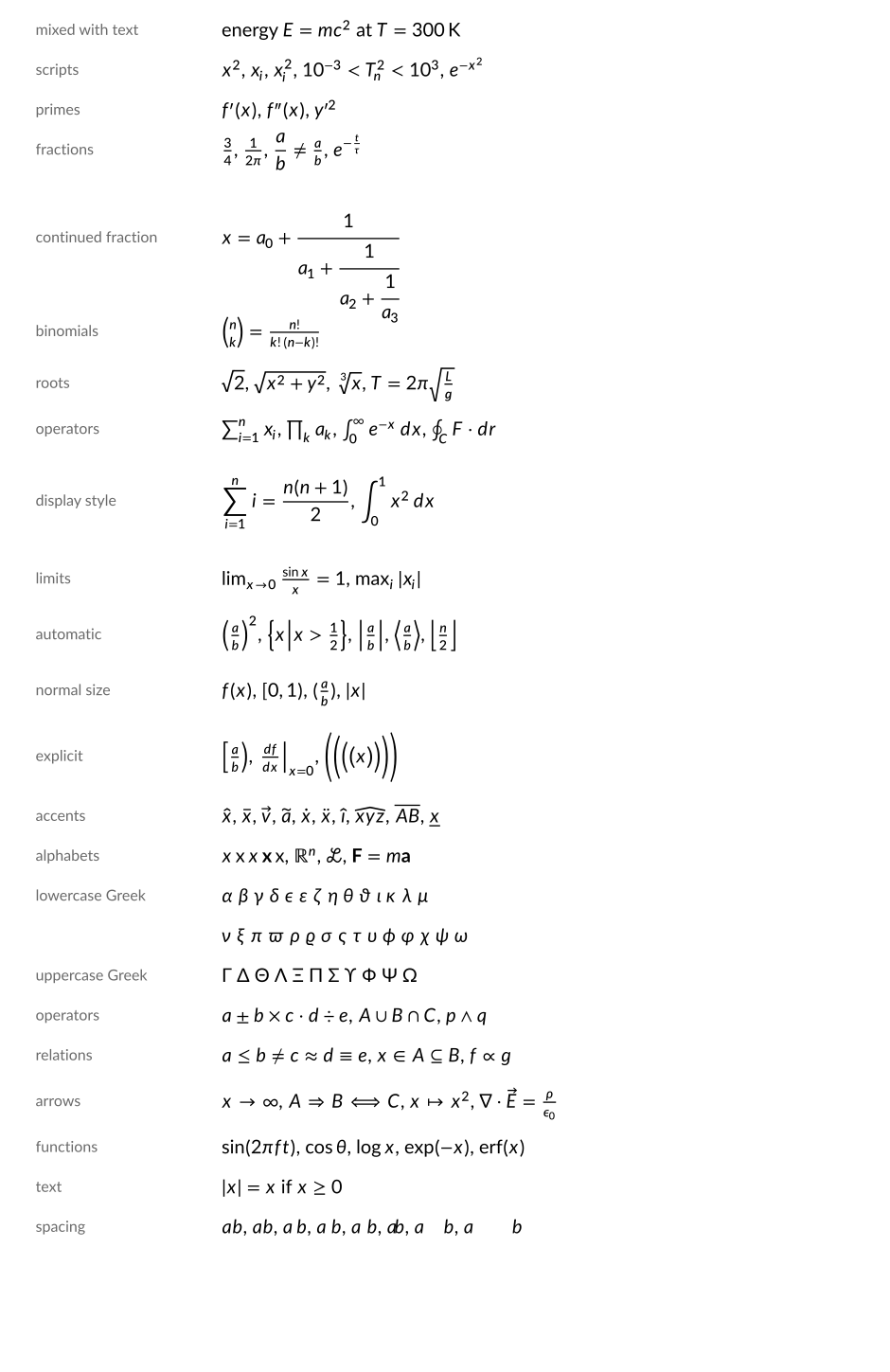
wrote mathtext_examples.svg
Total running time of the script: (0 minutes 0.038 seconds)